

Learning to heal
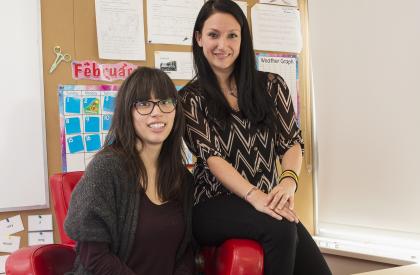
The Ronald McDonald House Charities Toronto (RMHC Toronto) School may be the size of the average two-bedroom apartment in Toronto, but don’t mistake it for being small in ambition or expectations of its students. In September 2003, the School opened in response to an increase in the number of families staying at the House for long periods. More than a decade later, the School continues to provide seriously ill children and their siblings with the opportunity to attend class and grow academically and intellectually, just like they would if they were living at home. Recognized as a private school by the Ontario Ministry of Education, the school follows the Ontario curriculum, is open to children from kindergarten to grade 12 and teaches all subjects, excluding French.
We recently sat down with the School’s two full-time teachers, Danielle Myers and Mishelle Garay, to hear about the unique challenges and rewards of teaching students while their families are in crisis.
You may be teaching anywhere from one to 20 students across all grades at any one time. What is that like as a teacher?
Mishelle: It certainly keeps every day fresh and interesting. Because our class rarely looks the same from day to day, week to week, we do a lot of planning in advance. Using the Ontario curriculum, we map out our long-range plans for the year so that no matter what age our students are at a given time, we know what their learning expectations are and we can assess them accordingly.
Do you prefer having more students or less?
Danielle: There are benefits to both. It can be nice to have a small group because that means one-on-one attention for them. A lot of these students are struggling academically. So if they’re able to get one-on-one attention from their teacher, they’re going to progress much more quickly.
M: And with what’s going on in their lives outside of school, that one-on-one attention can really help them emotionally as well.
D: On the other hand, when we have bigger numbers, it feels a little more like a classroom. The chairs are full, everyone has to raise their hand… It’s fun. In a bigger group, students have the option to choose their friends and are more likely to have someone else close to their age.
You mention that many of the students are facing academic challenges. Why do you think that is?
M: All of our students are either a patient or a sibling of a patient, and both situations can impact their schooling. If they’re a patient, they’ve been in the hospital or getting treatment and being pulled out of school regularly. If they’re a sibling, sometimes they’ve also been regularly pulled out of school or aren’t able to get the support at home that they ideally need. Their family has had to move and is in a state of upheaval, so unfortunately education often can’t be their top priority.
Do students have special emotional needs?
D: We often see behavioural and emotional issues. They may be upset because they didn’t get the sticker they wanted, but the underlying reason is clearly something deeper. Sick children don’t bring up their illness often, because they learn a lot about that at the hospital or through Child Life programming at the House. But when a student brings up their sick sibling, for example, we’ll stop everything and allow them to talk about it. We make sure they understand everything and feel that it’s okay to talk about it. Those conversations arise most often when another child dies and it has to be talked about in class. Then everyone wants to talk about their own stories.
What are the biggest challenges of teaching in this type of environment?
M: The biggest daily challenge is planning. Planning for all ages is pretty close to impossible. It’s not, because we do it, but it sometimes feels that way.
D: It doesn’t happen very often, but it’s extremely stressful when a child passes away. We’re well prepared for it: we have books, we teach the kids about memory building… But it’s not an easy day to walk into.
What do parents tell you about the School (or their children’s experiences in the School)?
M: Generally, parents are grateful that we’re enabling their children to continue their education during an otherwise difficult time. They’re experiencing so much stress and are forced to be away from home, so knowing that their children won’t fall behind in school is a major relief. And they’re also just pleasantly surprised at how typical our school really is. It may be smaller and have a range of grades, but essentially we’re teaching their children the exact same things they’d be learning at their regular school.
Why is it helpful for children living at the House to attend the RMHC Toronto School?
M: A main reason is that it provides them with a sense of normalcy. Attending school allows children, and even their parents, to maintain a big part of their regular life. School is a place to go that’s all about learning. It’s not about me being sick or my sibling being sick. It’s about, “What are Danielle and Mishelle going to make us do today?” Then there are the academic benefits, which are huge. They’re not falling behind. Once students have returned home, we often hear from their regular teachers how impressed they are with the progress they’ve made. With the one-on-one time that we’re able to offer, many students are moving beyond what’s happening at their own school.
D: Plus they get to make friends here and socialize. They get to be like a “normal” child.
What is the most rewarding part of teaching here?
D: We generally get to know students a lot better than you would in a classroom of 30 students. Chatting with them and hearing their personal stories is my favourite part.
M: Absolutely. The student-teacher relationships are hugely rewarding.
D: Children always tell us that they love the school, often to the point of not wanting to return to their regular school when they leave.
M: They’ll often say, “We wish this school existed back home! Can we keep coming even through we’re no longer living at the House?” Obviously that’s not really a good thing, but we’d be lying if we said it wasn’t satisfying to hear!
How the School helps

"For my son, attending the Ronald McDonald House Toronto School instilled in him the belief that, no matter what health issues there were, he could go on with his life." Parent of a Grade 10 student
Learn MoreDonate

Your donations have a direct impact on the lives of families at Ronald McDonald House Charities Toronto.
Donate Now